Source lemon turmeric bar soap for body care, laundry, and cleaning
Explore 30 listings for lemon turmeric bar soap featuring herbal ingredients, moisturizing properties, and custom branding options. Buyers can compare specifications like weight, scent, and certifications from manufacturers in China.
Key considerations
Products List







Comprehensive Sourcing Guide
Strategic Sourcing Guide for Lemon Turmeric Bar Soap Procurement
Navigating the global market for specialized personal care products requires a disciplined approach to verifying product attributes, supplier capabilities, and compliance standards. For buyers specifically researching lemon turmeric bar soap, the procurement process involves distinguishing between general laundry formulations and personal care applications, as the supply chain often blends these categories. The following guide outlines the critical factors for sourcing this specific item, grounded in observed market data and standard industry practices.
Technical Specifications and Product Attributes
The first step in sourcing is defining the precise technical specifications required for the product. Market observations indicate a diverse range of formulations under the broad category of bar soaps. For a lemon turmeric bar soap intended for personal use, the primary attributes to verify include the physical form, shape, and ingredient composition. Data from current listings suggests that while some products are classified as "General Laundry Soap," others are explicitly defined as "Hand soap" or "Bar Soap" with specific applications for the body.
Buyers must scrutinize the ingredient profile to ensure it aligns with the "Herbal" designation often associated with turmeric and lemon. The observed market includes products with "Chemical" ingredients as well, necessitating a clear distinction based on the buyer's brand positioning. Key physical specifications to confirm include the weight, which varies from sample sizes to bulk units like 160g or 208g. The shape is another variable; while some listings describe a "Round" shape, others specify a "Rectangle" form. Additionally, the transparency of the soap is a critical differentiator, with some products noted as "Transparent" and others as opaque.
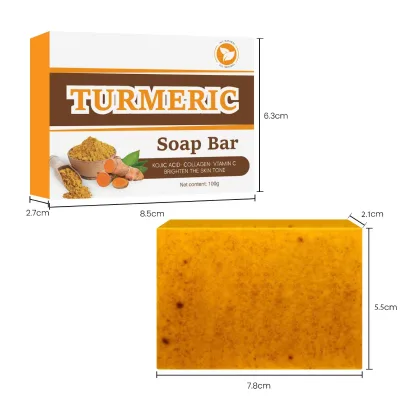
The packaging and presentation also play a vital role in the technical definition. Products may be sold as single items in polybags or bulk cartons containing multiple units, such as 12 pieces per carton. The single package dimensions, often observed around 9x3x7 cm, and the gross weight of approximately 0.14 kg per unit are essential for calculating logistics costs. Furthermore, the shelf life is a significant technical parameter, with some suppliers citing a duration of up to 10 years, which impacts inventory management strategies.
Compliance, Certification, and Safety Standards
Ensuring regulatory compliance is paramount when importing personal care products. The market data highlights specific certifications that buyers should request to verify supplier credibility. Observed listings mention compliance with ISO9001:2008 and SGS certification, which are standard indicators of quality management systems and product safety testing. However, buyers must not assume all suppliers possess these credentials; verification is required on a case-by-case basis.
Beyond general certifications, the specific standards for soap formulation must be checked. Some products reference a TFM (Total Fatty Matter) content of 43%, a metric often used to gauge the quality and cleansing efficiency of soap bars. Buyers should verify if this standard is fixed or if it can be customized to meet specific regional regulations or brand requirements. The "prod_standard" field in supplier data often mirrors the weight or specific formulation, so clarity is needed to ensure the standard applies to the chemical composition rather than just the packaging weight.
Safety and suitability are also critical compliance aspects. The product must be suitable for "All skin types" and "Adults," as indicated in various listings. For products marketed for body application, the absence of harmful additives and the presence of natural fragrances like lemon, turmeric, and ginger are key selling points. Buyers should request test reports confirming the absence of prohibited substances and verifying the safety of the herbal ingredients used in the formulation.
Cost Drivers and Pricing Dynamics
Understanding the cost structure of lemon turmeric bar soap is essential for budgeting and margin analysis. The observed price range in the market is extremely wide, spanning from $0.06 to $810. This vast disparity is not indicative of a single product tier but rather reflects the difference between raw material samples, bulk industrial orders, and specialized custom-branded units. The minimum order quantity (MOQ) is a primary driver of unit cost, with observed ranges from 1 piece to 130,000 pieces.
For buyers seeking a competitive unit price, the MOQ is the most significant lever. Suppliers often offer lower per-unit costs for orders approaching the higher end of the MOQ spectrum. The "Business Type" of the supplier, identified as "Manufacturer" in many listings, suggests that direct sourcing can eliminate middleman markups, potentially lowering costs. However, the complexity of customization, such as silk screen printing for logos or private labeling, can introduce additional setup fees that affect the final landed cost.
Logistics and trade terms also influence the total cost of ownership. Observed trade terms include CFR, CIF, FOB, and Ex Factory. The choice of Incoterm determines who bears the shipping and insurance costs, which can vary significantly based on the destination and the weight of the shipment. The single gross weight of 0.14 kg per unit, combined with the carton packing density, will directly impact freight charges. Buyers should calculate the cost per kilogram of the product, including packaging, to compare suppliers accurately.
Typical Applications and Market Segmentation
Lemon turmeric bar soap serves multiple market segments, and understanding the intended application is crucial for selecting the right supplier. The product data indicates a split between "General Laundry Soap" and personal care applications like "Body" or "Hand" washing. While turmeric and lemon are popular in personal care for their purported skin benefits, they are also used in laundry detergents for their cleaning and scent properties.
For personal care applications, the soap is marketed with features such as "Moisturizing," "Anti-Bacterial," "Refreshing," and "Whitening." The specific fragrance profile, including notes of lavender, rose, aloe, and strawberry alongside the core lemon and turmeric scents, allows for product differentiation. The "Herbal" ingredient claim supports marketing strategies targeting consumers seeking natural or organic personal care solutions.
In the laundry segment, the product is described as suitable for "All Clothes" and "Underwear," with features like "Anti-Bacterial" and "Refreshing" scents. The distinction between "Transparent Laundry Soap" and standard bar soaps suggests different manufacturing processes and end-use scenarios. Buyers must clearly define whether their target market is the personal hygiene sector or the household cleaning sector, as this dictates the required formulation and certification standards.
Supplier Evaluation and Verification
Evaluating suppliers requires a systematic approach to verifying their capabilities and reliability. The "Business Type" of Manufacturer is a strong indicator of production control, but buyers should still verify the supplier's physical location and operational capacity. Observed origins include Guangdong and Hebei, China, which are major manufacturing hubs. Buyers should confirm the specific "place of origin" to ensure it aligns with their sourcing strategy regarding logistics and regional trade agreements.
Customization capabilities are a key differentiator. The market data confirms that "Customization" is available, including "OEM ODM Private Label" services and "Silk Screen Printing" for logos. Buyers should assess the supplier's flexibility in adjusting the "prod_model" and "model number" to meet specific branding needs. The ability to customize the "TFM" content or the specific blend of herbal ingredients is also a critical evaluation point.
Service levels, such as the availability of samples and the "Selling Units" structure, should be reviewed. The observation of "sample size" availability allows buyers to test product quality before committing to large orders. Additionally, the "Shelf Life" of 10 years is a notable attribute that suggests stable formulations, but buyers should verify if this applies to the specific batch they are ordering.
Quality Control and Long-Term Procurement
Implementing a robust quality control (QC) protocol is essential for maintaining product consistency. Given the variation in attributes like shape, transparency, and ingredient composition, buyers should establish clear acceptance criteria before production begins. The "Feature" list, which includes "Moisturizing," "Refreshing," and "Whitening," should be validated through sensory testing and chemical analysis to ensure the claims are substantiated.
Long-term procurement considerations involve building a sustainable supply chain. The "Service" of OEM/ODM implies a partnership model where the supplier adapts to the buyer's evolving needs. Buyers should negotiate terms that allow for scalability, considering the wide MOQ range observed. The "Single package size" and "prod_packing" specifications must be optimized for storage and transport to minimize damage and maximize efficiency.
Finally, buyers should monitor the "Trade Terms" and payment conditions to manage cash flow and risk. The availability of terms like FOB and CIF offers flexibility in managing logistics. By maintaining open communication regarding product standards, such as the TFM percentage and ingredient lists, buyers can ensure that the lemon turmeric bar soap meets their quality expectations and regulatory requirements over the long term.
| Attribute Category | Observed Variations | Verification Requirement |
|---|---|---|
| Form & Shape | Round, Rectangle, Solid | Confirm physical dimensions and shape consistency. |
| Ingredients | Herbal, Chemical, Ginger, Lemon, Turmeric | Verify ingredient list and safety data sheets. |
| Application | Body, Hand, All Clothes, Underwear | Define target market to select correct formulation. |
| Certification | ISO9001:2008, SGS | Request valid certificates for each production batch. |
| Packaging | Polybag, Carton, 1.5kg*12PCS/Carton | Confirm packaging durability and labeling accuracy. |
| Weight | 160g, 208g, 0.14kg (Gross) | Verify net weight and gross weight for shipping. |
| Standard | TFM 43%, 208g | Confirm TFM content and standard applicability. |
FAQs
What ingredients are used in lemon turmeric bar soap?
The soap typically contains herbal ingredients like ginger, lemon, and turmeric. Some formulations may also include chemical components, so buyers must verify the specific ingredient list to ensure it matches their brand requirements.
Can I customize the logo on the soap packaging?
Yes, customization is available including silk screen printing for logos. Suppliers offer OEM and ODM private label services, allowing you to add your graphic design to the product for a branded finish.
What is the minimum order quantity for this soap?
The minimum order quantity can be as low as 1 piece for samples. Bulk orders may require higher quantities up to 130,000 pieces, with unit costs varying significantly based on the chosen volume.
Where are these manufacturers located?
Manufacturers are located in China, specifically in Guangdong and Hebei provinces. Buyers should confirm the exact place of origin to ensure it aligns with their logistics and regional trade strategy.
What certifications do the suppliers hold?
Some suppliers hold ISO9001:2008 and SGS certifications for quality and safety. Buyers should request valid certificates for each production batch to verify compliance with international standards before placing large orders.
How long is the shelf life of the product?
The shelf life can be up to 10 years for stable formulations. This duration impacts inventory management, but buyers should verify if this applies to the specific batch they are ordering.
What are the available product shapes and forms?
The soap is available in solid form with round or rectangle shapes. Specifications vary, with some products being transparent laundry soap while others are opaque hand soaps designed for body application.